reamz45
The Future of Custom Logistics Software Development: Unlocking Efficiency, Ownership, and Enterprise Scale

Modern supply chains operate under unprecedented pressure. Rapidly shifting consumer demands, volatile fuel costs, complex global trade compliance, and multi-carrier dependencies require logistics software development services that move with absolute agility. Yet, many organizations remain restricted by off-the-shelf software platforms. Generic platforms force logistics managers into rigid workflows, burden growing teams with per-seat or per-shipment licensing fees, and fail to adapt to specialized operational requirements.
Building tailored systems through modern custom logistics software development services allows enterprises to gain direct ownership of their technology stack while engineering platforms that align exactly with how their business runs.
Why Off-The-Shelf Logistics Software Falls Short
SaaS logistics platforms are designed for the average enterprise, but high-performing supply chain operations are rarely average. When growing businesses rely on generic applications, they encounter fundamental bottlenecks that limit long-term profitability and operational velocity:
- High Scaling Costs: Traditional SaaS vendors rely on recurring user fees or per-shipment charges, which turn software into a major line item as operational volumes scale.
- Legacy Architectural Lock-In: Third-party vendors control the product roadmap, meaning critical feature updates or specialized integrations can take months or years to materialize.
- Workflow Fragmentation: When software cannot adapt to proprietary rating structures, warehouse layouts, or carrier selection rules, operators are forced to plug gaps using manual spreadsheets and disparate tools.
- Lack of Code Ownership: Businesses paying subscription fees build no long-term equity in their digital infrastructure.
Partnering with an experienced custom logistics software development company allows enterprises to eliminate these constraints by creating systems built directly around their operational rules, carrier ecosystems, and strategic goals.
Strategic Capabilities of Modern Logistics Engineering
Creating a tailored digital logistics ecosystem involves uniting core operational components under a unified platform. Rather than managing separate systems for transportation, warehousing, and carrier relationships, modern engineering connects these components seamlessly.
Transportation Management Systems (TMS)
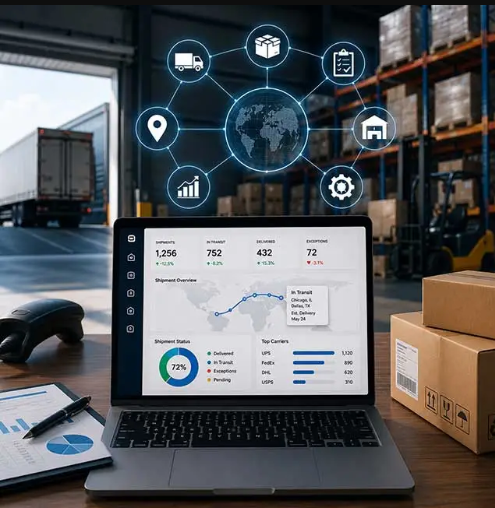
An enterprise-grade transportation management system serves as the central control tower for freight movements. Tailored TMS applications handle end-to-end shipment lifecycles, including order intake, load consolidation, automated dispatching, track-and-trace monitoring, and carrier settlement. By integrating automated rating engines and compliance checks, operations achieve full visibility while reducing administrative overhead.
Warehouse Management Systems (WMS) and Inventory Tracking
Efficient supply chains depend on absolute warehouse accuracy. Specialized warehouse software provides end-to-end control over receiving, directed putaway, picking, packing, and dispatching. With real-time RFID tracking and automated barcode scanning integrated into the cloud, warehouse teams maintain a single source of truth for inventory positions across multiple distribution centers.
Multi-Carrier Shipping and Fleet Analytics
Managing multi-carrier shipping requires real-time rate comparison across parcel, less-than-truckload (LTL), full truckload (FTL), and intermodal networks. Custom shipping engines execute live rate shopping across hundreds of carrier APIs simultaneously, generating compliant labels and customs documentation in milliseconds. Paired with telemetry-driven fleet management tools, fleet managers gain complete insight into driver behavior, vehicle maintenance schedules, fuel consumption, and Hours of Service (HOS) compliance.
Accelerating Supply Chain Performance with Artificial Intelligence
Integrating artificial intelligence directly into logistics architecture changes how supply chains make decisions. Rather than relying solely on reactive updates, modern systems leverage intelligent automation to anticipate disruptions and streamline daily execution:
- Intelligent Carrier Selection: AI algorithms evaluate carrier scorecards, historical performance, lane pricing, and real-time capacity to rank and award tenders automatically within milliseconds.
- Dynamic Route Optimization: Machine learning models solve complex vehicle routing problems by calculating real-time traffic conditions, customer delivery windows, vehicle payload limits, and driver availability to minimize fuel usage and maximize daily stops.
- Automated Document Processing: Advanced vision systems and large language models extract data directly from Bills of Lading (BOL), Proof of Delivery (POD) receipts, and customs documentation, enabling high straight-through processing rates and eliminating manual data entry errors.
- Predictive Freight Analytics: Machine learning algorithms analyze historical shipping trends and external data sources to project demand, detect spend anomalies, and provide precise estimated arrival times.
Building Cloud-Native Systems with Enterprise Security
Modern logistics demand high availability, robust data security, and seamless integration capabilities across external and internal networks.
Custom software development relies on cloud-native architectures deployed on AWS or Azure using microservices and Kubernetes orchestration. This structure ensures that systems auto-scale seamlessly during high-volume surges, such as peak holiday shipping periods, without performance degradation or emergency operational costs.
Security remains critical when handling sensitive shipment records, customer data, and commercial carrier contracts. Platforms must adhere to international standards, incorporating ISO 27001 certifications, SOC 2 Type II compliance, robust role-based access control (RBAC), end-to-end encryption, and comprehensive audit logs. Furthermore, open REST APIs, EDI X12/EDIFACT standards, and direct connectors ensure friction-free data flow with enterprise systems like SAP, Oracle, NetSuite, Dynamics 365, and major e-commerce platforms.
Conclusion
Transitioning away from custom logistics software development off-the-shelf software to a platform engineered around your operational needs offers a decisive competitive advantage. By leveraging pre-tested modular components combined with artificial intelligence, organizations can deploy high-performing platforms quickly while maintaining absolute control over their code base. Developing tailored software eliminates recurring per-seat subscription fees, streamlines complex multi-carrier operations, and provides the scalability needed to handle future growth. Investing in proprietary digital infrastructure empowers transportation and logistics leaders to reduce freight spend, optimize operational efficiency, and deliver superior reliability across the entire global supply chain.
Príbuzné tagy: aena54